White-Label AI Platform for Agencies: What to Check First
What a white-label AI platform gives an agency, which AI services to resell first, where the margin sits, and the questions to ask a provider in writing.
A white-label AI platform is AI software that another company builds and operates, which an agency sells and delivers under its own brand. The client sees the agency's name; the models, the hosting and the roadmap belong to the provider. It is how marketing agencies, consultancies, IT resellers and managed-service providers in Dubai and the UAE answer the question that now comes up in most client meetings: "Can you do our AI as well?"
This guide is for the agency owner or director deciding whether to answer yes with someone else's platform. It covers what a white-label AI platform actually includes, which white-label AI services agencies sell and which to sell first, the difference between a white-label AI agent and a rebadged chat tool, what the margin looks like once support is counted, the questions to put to a provider in writing, what is different for a UAE agency, and when the model is the wrong answer.
The short answer
Three things decide whether white-label AI works for an agency, and none of them is the technology. First, whose name is on the contract with the end client: if it is the platform's, you are an introducer earning a fee, not a supplier with a relationship. Second, the margin after support hours, not the margin on the rate card; the support desk is yours the day you sign, and it is the cost most agencies discover in month three. Third, what you can take with you if you leave: the prompts, the workflow configuration, the conversation history and the client list. Establish all three in writing before signing, start with one service for one client at cost, and price from what that client actually costs you.
What a White-Label AI Platform Includes, and What It Does Not
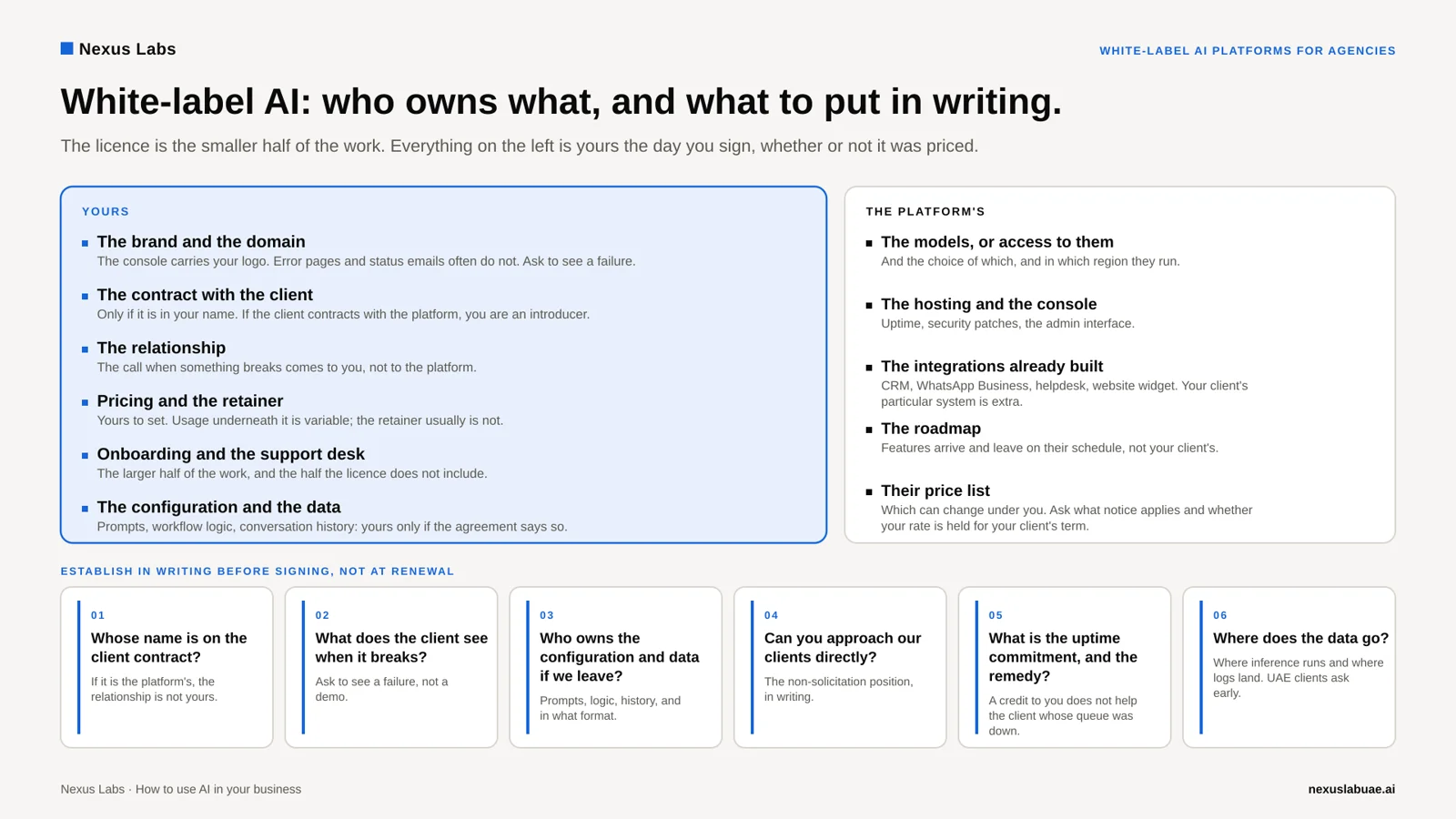
The provider supplies the working software: the models or access to them, the hosting, an admin console, the integrations it has already built (typically a CRM, WhatsApp Business, a helpdesk and a website widget), uptime, security patches and the roadmap. You get the console with your logo on it, a domain of your own and, usually, a reseller price list.
What the platform does not supply is everything that makes the service worth paying for: understanding the client's workflow, deciding what the agent may and may not do, assembling the client's knowledge base, connecting the client's particular systems, handling the exceptions, and answering the phone when something goes wrong. The licence is the smaller half of the work. Agencies that price as if it were the larger half are the ones that struggle, and the sections on margin and sequence below are about that.
Which White-Label AI Services Agencies Actually Sell
Most of the demand falls into five services, and they are not equally easy to deliver.
- Customer response agents. An agent that answers enquiries on WhatsApp, the website and email from the client's own information, books the next step and hands the rest to a person. The most asked-for service in the UAE, because most of the queue arrives on WhatsApp, in Arabic and English, outside office hours. The delivery effort is in the knowledge base and the handoff, not the software. See automating customer service with AI agents.
- Lead qualification and follow-up. Instant replies to new leads, qualifying questions, CRM entry, follow-up until there is an answer. Valuable for the client, sensitive to get wrong, and subject to the UAE's telemarketing rules the moment anything outbound is involved. See AI sales agents in the UAE.
- Content and marketing automation. Drafting, scheduling, reporting. The easiest to resell and the hardest to differentiate, because the client can buy the same tool directly and will eventually notice.
- Document and data-entry automation. Reading invoices, IDs and contracts into the client's systems, with checks. Good economics where the volume exists; it needs a provider that handles Arabic and bilingual documents, which should be demonstrated on the client's own paperwork. See AI document processing in the UAE.
- Reporting and dashboards. Plain-language questions over the client's data. Depends entirely on the condition of that data, which the agency rarely controls and should not promise around.
Start with the one most of your existing clients already ask about. For most UAE agencies that is customer response, and the reason it sells is in the next section.
A White-Label AI Agent Is Not a Rebadged Chatbot
Many products sold as "white-label AI" are a chat interface over a general model with your logo on it. That is a chatbot: it answers from what it has been told and stops. An agent does something afterwards. It reads the client's CRM record, books the viewing, raises the ticket, updates the order, and reports back. The difference decides what you can charge, because clients pay a retainer for work being done and a subscription for questions being answered, and those are different prices.
Before putting your name on a platform, ask to see it complete a task inside a real system, not answer a question about one. The distinction is set out in AI agents versus chatbots. An agency that sells the second as the first has a short client relationship ahead of it.
What the Margin Actually Looks Like
White-label AI is usually sold to agencies on revenue and rarely on cost structure, which is where the model succeeds or fails. Four costs are consistently underestimated in the proposal stage.
- Usage is variable and your pricing is probably not. Most platforms charge per token, per conversation or per seat, and most agencies bill a flat monthly retainer. A single heavy client can erase the margin on three others. Cap usage in the contract or price with a usage band, and model the worst case before you sign.
- Support is yours now. The client calls you, not the platform. Every misfire, every wrong answer, every integration that stops returning a field arrives at your service desk. Budget the hours honestly; this is the cost most agencies discover in month three.
- Onboarding does not shrink much with volume. The technology is reusable. Understanding a new client's workflow, agreeing what their entities mean and connecting their particular CRM is not, and it is most of the effort per client.
- The platform's price rises. You are reselling something whose cost you do not control. Ask what notice period applies to pricing changes, and whether your rate is contractually held for the term of your own client agreements.
Questions to Ask a Platform Before You Commit
These separate a genuine white-label arrangement from a reseller agreement with a logo swap. Ask them in writing.
- "Whose name is on the contract with my client?" If the end client contracts with the platform, you are an introducer, not a supplier, and the relationship is not yours.
- "What does the client see if something breaks?" Error pages, emails and status notifications frequently carry the platform's branding even when the interface does not. Ask to see a failure, not a demo.
- "Who owns the configuration and the data if I leave?" The prompts, the workflow logic, the fine-tuning and the conversation history. Establish this before signing, not at renewal.
- "Can you approach my clients directly?" Get the non-solicitation position in writing. A platform that can see your client list and sell to it is a competitor with unusually good market intelligence.
- "What is your uptime commitment, and what happens when you miss it?" A service credit to you does not help when the client's support queue was down for a day and your name is on it.
- "How do you handle data residency?" If your clients are in the UAE, where inference runs and where logs land are questions the client's own compliance team will eventually ask you.
What Is Different for a UAE Agency
- Clients will ask where the data goes, and increasingly early. The UAE's Personal Data Protection Law, and the separate regimes in the DIFC and ADGM, mean a client in a free zone may have obligations your platform's default configuration does not satisfy. Know the answer before the question; the framework is in AI governance and data privacy in the UAE.
- Arabic support is a differentiator and a genuine test. Ask for a live demonstration in Arabic rather than a claim of support. Quality varies enormously, and right-to-left interface handling is frequently an afterthought.
- WhatsApp is not optional here. A platform without solid WhatsApp Business Platform support is missing the channel most UAE client conversations actually happen on, and Meta's own terms for AI on the channel apply to your clients through you. See WhatsApp AI chatbot rules in the UAE.
- Two working weeks. The UAE works Monday to Friday; Saudi Arabia, where many Dubai agencies also have clients, works Sunday to Thursday. Business-hours routing, scheduled reports and escalation windows have to be configurable per client and per country. Platforms built elsewhere often hard-code one default, and it fails silently rather than visibly.
When White-Label Is the Wrong Answer
Honest cases where the model does not fit:
- You have one client who wants this. The economics only work across a portfolio. For one client, a direct partnership or a referral fee is better for everyone.
- Your differentiation is the technology itself. If clients buy you because of what you build, reselling someone else's platform under your name undermines the reason they chose you.
- You cannot staff the support. White-label transfers the client relationship to you, including the parts that go wrong at inconvenient times.
- Your clients are large enough to procure directly. Enterprise buyers will eventually ask what is underneath, and the answer is discoverable.
A Realistic Sequence
- Pick one service, not a platform. Choose the single AI capability most of your clients already ask about, and sell that. A menu of eight is harder to sell and harder to support.
- Run it for one client at cost. You will discover your real support burden and your real onboarding time. Both will be higher than the estimate.
- Price from that measurement. Not from the platform's suggested retail, which reflects their costs rather than yours.
- Standardise onboarding before the third client. The same questions, the same definitions document, the same integration checklist. This is where margin comes from at volume.
- Add a second service only once the first is profitable and quiet.
How to Tell Whether It Is Working
- Gross margin per client after support hours. Not revenue. The support time is the variable that decides this and it is the one nobody tracks.
- Onboarding time, client three versus client eight. If it is not falling, you have not productised anything.
- Support tickets per client per month, trending. Rising means the configuration is wrong, not that clients are demanding.
- Renewal rate at twelve months. The only measure that reflects whether the service was worth buying.
How Nexus Labs Works With Agencies
Nexus Labs AI, also known as Nexus Labs UAE, is an AI company in Dubai that builds AI employees and workflows for businesses in the UAE and the GCC, and is the UAE implementation partner for three production AI platforms. For an agency, that means the delivery half of the work described above (scoping what the agent may do, assembling the knowledge base, connecting the client's CRM and WhatsApp, the human gates and the logging) can sit with us behind your client relationship, under a partner arrangement in which the questions in this guide are answered in writing first. Custom AI agents describes what gets built; to discuss a partner arrangement, get in touch.
Where to Go Next
Before choosing a platform to resell, be clear on what you are reselling: agents versus chatbots. If your agency is an IT provider or MSP, AI for IT service desks and MSPs in the UAE covers delivery across tenants, which is the harder version of the same problem. The questions a client's compliance team will put to you are in AI governance and data privacy in the UAE, and the questions to put to any provider, platform or otherwise, are in how to choose an AI automation company in Dubai. Our services page sets out the layers we build; to discuss a partner arrangement, get in touch.
Frequently Asked Questions (FAQ)
What is a white-label AI platform?
It is AI software that another company builds and operates, which an agency sells and delivers under its own brand. The client sees the agency's name; the models, hosting and roadmap are the provider's. It is how agencies and consultancies offer AI services without building a product, and the trade is control: you gain time to market and give up some influence over pricing, the roadmap and, depending on the agreement, the client relationship itself.
What is the difference between white-label and reselling?
Whose name is on the contract with the end client. In a genuine white-label arrangement the client contracts with you, you own the relationship, and the platform is invisible to them. If the client contracts with the platform, you are an introducer earning a fee, and the relationship is not yours to keep. Ask this in writing before signing.
Which white-label AI services sell best for an agency?
In the UAE, customer response agents on WhatsApp, the website and email, because that is where most clients feel the pain and the queue arrives in two languages outside office hours. Lead qualification and follow-up is next, with the telemarketing rules in mind for anything outbound. Content automation is the easiest to resell and the hardest to differentiate. Start with the one service most of your existing clients already ask about.
What is a white-label AI agent, as opposed to a chatbot?
A chatbot answers from what it has been told and stops. An agent completes a task afterwards: it reads the client's CRM record, books the appointment, raises the ticket or updates the order, and reports back. Many products sold as white-label AI are chat interfaces with your logo on them. Ask to see the platform complete a task inside a real system before putting your name on it.
What margin should we expect on a white-label AI service?
It depends far more on your support burden than on the platform's rate card, and support is the cost most agencies discover in month three. Run one client at cost first, measure the actual onboarding and support hours, then price from that measurement rather than from the platform's suggested retail, which reflects their cost structure, not yours.
What happens to our clients if we leave the platform?
That depends entirely on terms you should establish before signing, not at renewal. Ask who owns the prompts, the workflow configuration, any fine-tuning and the conversation history, and in what format you can export them. Ask separately whether the platform is permitted to approach your clients directly: a supplier who can see your client list and sell to it is a competitor with unusually good market intelligence.
Do we need a technical team to white-label AI?
Partly, and it is worth being honest about the limit. A white-label arrangement removes the need to build and operate the platform, not the need to understand the client's systems, scope what the AI should and should not do, and handle the cases it cannot. Agencies that succeed here have someone who can hold a technical conversation with a client's IT team, even if nobody writes code.
How do white-label AI platforms handle data security and privacy for UAE clients?
The platform's certifications describe the platform, not your deployment. For a UAE client you need to be able to say where inference runs and where logs are stored, whether the client's data is used to train anyone's models (the answer should be no, in writing), how long conversations are kept, and who can access them. If the platform processes personal data outside the UAE, that is a transfer under the UAE's data protection regimes and it needs a basis. This is general information, not legal advice.