Secure Enterprise AI on AWS Bedrock in the UAE: What Stays Yours
What AWS Bedrock secures and what stays yours when a UAE business deploys AI agents: the UAE Region, cross-Region inference, access scope, PDPL and a checklist.
Securing enterprise AI on AWS Bedrock means deciding, before an agent reads its first record, where inference runs, what the agent can reach, what it can do while it is wrong, and what gets kept. The platform secures the infrastructure; those four decisions stay with you, and they are the ones a regulator asks about. In the UAE they have to be taken earlier than elsewhere, because the Personal Data Protection Law, the separate DIFC and ADGM regimes, and the limits of the UAE Region's model list all bear on the first of them.
This guide is for the person who has to sign off an AI deployment and wants to know what "built on AWS Bedrock" does and does not settle. It covers what the platform secures and what stays yours, what is different about doing this in the UAE, the three ways AI systems fail that a conventional security review misses, where your data physically sits, what Bedrock does not do, a deployment checklist, and the common mistakes. It is written for businesses in Dubai and the UAE; the method holds anywhere. It is operational guidance, not legal advice.
The short answer
Treat Bedrock as the floor, not the ceiling. AWS secures the service: encryption, isolation between customers, your data not used to train the base models, the audit mechanism. You configure the controls it gives you: the Region, whether cross-Region inference is on, a role per agent, logging and retention. And you design the part no platform setting covers: what the agent can reach, a human gate on anything that acts, and a way to stop it. Decide the Region first, because at the time of writing the models most teams want reach the UAE Region only through cross-Region inference, which sends the request somewhere else. Then scope each agent to the records it needs, not to everything its role could see.
What Bedrock secures, and what stays yours
Three kinds of thing are sold under "enterprise-grade security", and the sales conversation runs them together. They are different layers with different owners.
- What AWS secures. The physical infrastructure, the service, encryption at rest and in transit, isolation between customers, and the commitment that your prompts and fine-tuning data are not used to improve the base models. The platform's certifications describe this layer. It is real, and it is the part you cannot get wrong.
- What you configure. Which Region inference runs in, and whether cross-Region inference is enabled. A separate IAM role for each agent. Private connectivity from your own network. Guardrails for the categories of content you will not accept. The logging that CloudTrail and CloudWatch can give you, and a retention period someone decided. Every one of these has a default, and the default was chosen for convenience rather than for your compliance position.
- What you design. What the agent can reach, which is a question about your CRM, your document store and your messaging platform rather than about Bedrock. What it is permitted to do without a person. What happens when an instruction hidden in a document redirects it. How what it writes back is validated, and how it is stopped. No platform setting covers this layer; it is the architecture.
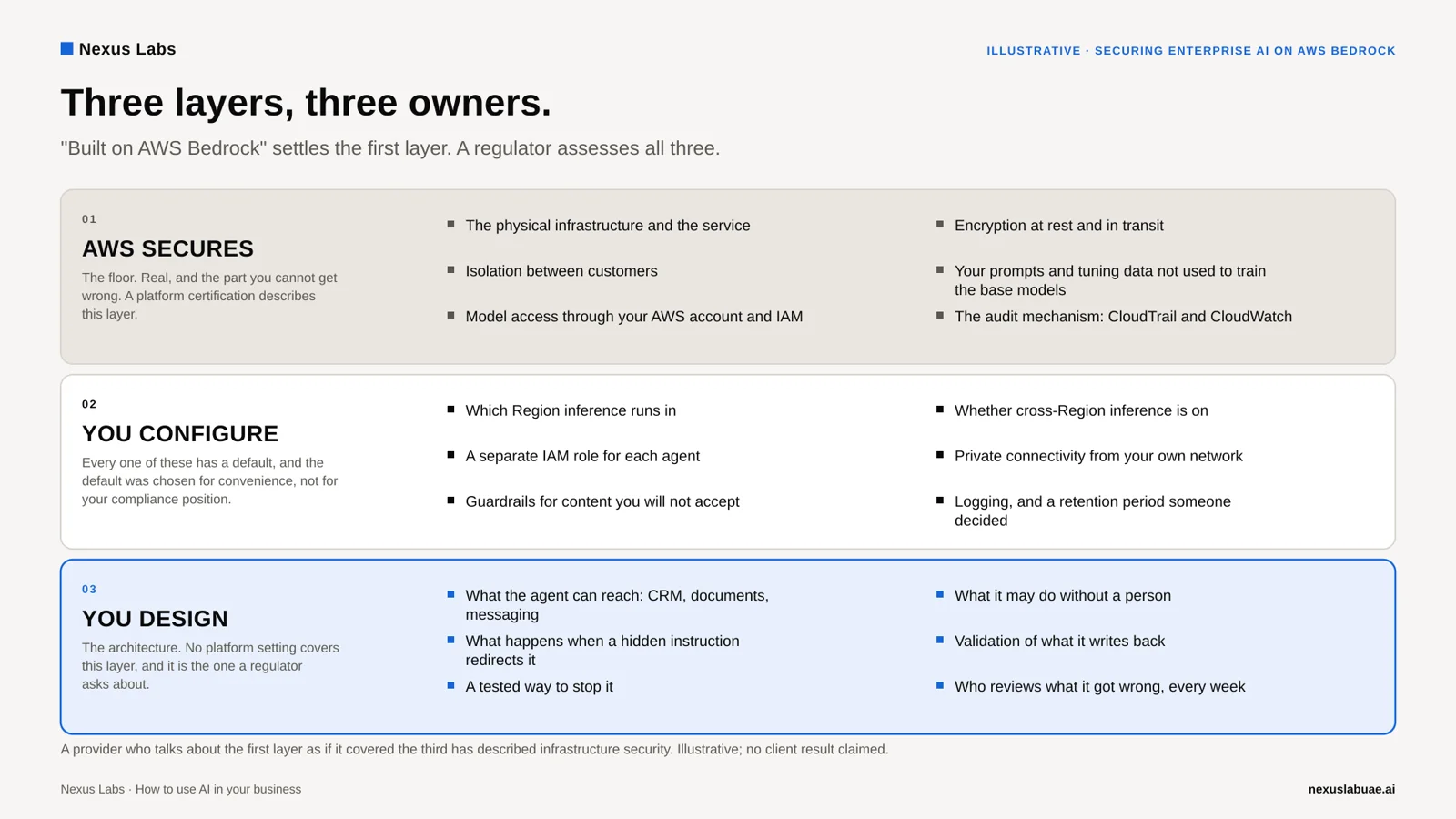
A provider who talks about the first layer as if it covered the third has described infrastructure security. The rest of this guide is about the second and the third.
What is different in the UAE
- The UAE Region has Bedrock, with a short in-region list. Amazon Bedrock has been available in the AWS Middle East (UAE) Region since September 2025. At the time of writing, AWS's own region table lists the major third-party models for that Region, including the Claude family, only through global cross-Region inference: the request is routed to a supported Region anywhere in the world to be served. That is a cross-border transfer of whatever is in the prompt. It may be acceptable for your data; it is not acceptable by accident. Check the table before committing to a model, because it changes as AWS expands coverage.
- Three data protection regimes, not one. The federal Personal Data Protection Law on the mainland, and the DIFC and ADGM laws in the financial free zones, each with its own regulator and its own requirements. An entity in DIFC is not covered by assuming federal compliance, and a group with entities in more than one jurisdiction has more than one set of obligations for the same agent. Where an AI system processes personal data, they apply whichever cloud it runs on, and to a pilot as much as to production.
- The prompt is the customer conversation. Most of the queue arrives on WhatsApp, in Arabic and English, and the agent sees the whole thread: names, numbers, images of Emirates IDs, complaints. Logs, traces and prompt histories then contain the same personal data as the request. Where those are stored and for how long are the questions teams forget to ask. The service-queue side is covered in AI customer service automation in the UAE.
- Sector rules sit on top. Health data and financial data carry additional handling and residency expectations from their own regulators, and those are frequently stricter than the general data protection position.
The governance side of the same decision, lawful basis, data subject rights and the operating controls, is covered in AI governance and data privacy in the UAE. This guide is the platform side. Any organisation deploying AI against personal data should take its own advice on which regimes apply to its specific entity structure.
What "Secure" Has to Mean for an AI System
Security for a conventional application is largely about who can reach what. AI systems add three failure modes that traditional controls were not designed for, and a review that only covers access control will miss all three.
- The model can be talked into things. An instruction hidden in a document, an email or a customer message can redirect an agent that reads it. This is prompt injection, and it is not a bug that gets patched — it is a consequence of a system that treats text as instructions. The control is architectural: limit what the agent is permitted to do, rather than trying to sanitise what it reads.
- Data leaves through the output, not the database. An agent with legitimate read access to a CRM can be induced to summarise it to someone who should not see it. Nothing is breached. Permissions were respected. The information still moved.
- Actions are harder to reverse than queries. A reporting model that is wrong produces a bad number. An agent that can send messages, update records or issue refunds produces consequences. The security question is not "can it be wrong" but "what can it do while it is wrong".
A provider who discusses encryption and IAM but not these three has described infrastructure security, not AI security.
Where Your Data Physically Sits
Data residency is the single most consequential architectural decision in a regulated AI deployment, and it is usually made by accident — by whoever picked the region when the account was opened, or by a routing option that was on by default.
AWS operates the Middle East (UAE) Region in the country, and Bedrock has been available in it since September 2025, but Bedrock's availability and the specific foundation models offered differ by Region. At the time of writing the Region's in-region model list is short, and the major third-party models are listed for it only through global cross-Region inference, which routes the request to a supported Region anywhere in the world and so moves the prompt out of the country. If the agent processes personal data and the model runs outside the country, that is a transfer, and it needs a lawful basis. Teams design against a model that runs in-region in the United States, then discover at deployment that the Region their compliance position requires does not serve it in-region. Confirm current regional model availability, and how the request is routed, before committing to a model, not after — this changes as AWS expands coverage, so check AWS's region table rather than relying on any document, including this one.
Three questions worth settling in writing at design time:
- Which region will inference run in, and does that satisfy the residency position for the data involved?
- Where do logs, traces and prompt histories go? These frequently contain the same personal data as the request, and they are routinely sent somewhere else.
- If a required model is not available in the compliant region, what is the fallback — a different model, or a different architecture?
What Bedrock Does Not Do
Managed services shift work; they do not remove responsibility. Under the shared responsibility model, AWS secures the infrastructure and the service. Everything above that line remains yours, and that includes most of what determines whether a deployment is safe.
- It does not make you compliant. The platform provides controls. Whether they are configured correctly, whether your processing has a lawful basis, and whether your retention is defensible are all questions about your implementation.
- It does not stop prompt injection. Content filtering catches categories of harmful output. It does not detect that an instruction embedded in a supplier invoice has redirected your agent.
- It does not constrain what your agent can reach. If you give an agent broad credentials to a CRM, the platform will faithfully let it use them.
- It does not review your prompts. Sensitive data pasted into a system prompt is sensitive data in your configuration.
The value is real: private inference within your own network boundary, fine-tuning that does not feed the base model, and audit logging that a regulator will accept. Those are genuine and non-trivial. They are also the floor, not the ceiling.
A Deployment Checklist
What to establish before an AI system touches production data. None of it is exotic; the failures are almost always omissions rather than sophistication.
- Least privilege, enforced per agent. Each agent gets its own role, scoped to the specific records and actions it needs. Not a shared service account with broad read access because it was faster to set up.
- A human gate on consequential actions. Sending, paying, deleting and externally communicating should require approval until the system has a track record. Reading and drafting do not.
- Logging that reconstructs a decision. When someone asks why the agent did something in April, you need the input, the retrieved context and the action. CloudTrail and CloudWatch give you the mechanism; whether your logs actually answer that question is a design choice.
- Retention that someone decided. Prompt and output logs accumulate personal data by default. Decide how long they live and enforce it, or you have built an unplanned data store.
- Output validation before action. If the agent updates a record, validate the shape and range of what it produces. Most damaging errors are plausible-looking values, not obvious nonsense.
- A tested revocation path. How do you stop it, at 2am, without a deployment? If nobody has tried, you do not have one.
Common Mistakes
- Giving the pilot production credentials. A proof of concept becomes the production system more often than anyone plans for, and its permissions come with it.
- Treating the model as the security boundary. Instructing a model not to reveal something is a request, not a control. If it must not be disclosed, it must not be reachable.
- Choosing the region for latency alone. A few milliseconds is rarely worth a residency position you cannot defend.
- Skipping the data protection assessment because "it is just a pilot". Pilots process real personal data. The obligations do not wait for general availability.
- Assuming a compliance certification transfers. A platform's certifications describe the platform. Your deployment on it is assessed separately.
What This Looks Like in Practice
Nexus Labs integrates AI agents with the systems businesses already run — CRM, WhatsApp, ticketing, internal databases. Security is the constraint that shapes those integrations rather than a review at the end, because the decisions that matter most are made when the architecture is drawn: which region, which credentials, which actions need a human, what gets logged and for how long.
We build on AWS services including Bedrock where they fit the requirement. We are not an AWS partner and nothing here should be read as an endorsement by AWS; the platform is a tool we use, and the design decisions above are ours and yours to make correctly.
Where to Go Next
Security is one half of the question and governance is the other — AI governance and data privacy in the UAE covers the PDPL side of the same decision. For where these controls sit architecturally, see the operating layer, and for choosing a first workflow that fails safely while they are being put in place, enterprise AI automation in the UAE. The questions to put to a provider about where your data is processed and who is accountable are in choosing an AI automation company in Dubai. The agents we build to these constraints are described on custom AI agents, and our AI services page covers the rest. And for how an engagement runs end to end, see how we work as an AI automation company in Dubai.
Frequently Asked Questions (FAQ)
- Q: Is AWS Bedrock available in the UAE?
- A: Yes. Amazon Bedrock has been available in the AWS Middle East (UAE) Region since September 2025. What matters for data residency is which models run in-region: at the time of writing, AWS's region table lists the major third-party models for that Region, including the Claude family, only through global cross-Region inference, which routes the request to another Region. Check the table before committing to a model, because it changes.
- Q: What is cross-Region inference, and does it matter for data residency?
- A: It is a Bedrock routing option that sends a request to another Region, or to any supported Region worldwide, to be served. It is convenient for capacity, but the prompt and the response leave the Region you chose. If the prompt contains personal data, that is a cross-border transfer under the UAE's data protection regimes and it needs a lawful basis. Decide it at design time, not after a regulator asks.
- Q: Who is responsible for security on AWS Bedrock, AWS or us?
- A: Both, at different layers. AWS secures the infrastructure and the service: encryption, isolation between customers, and not training its base models on your data. You configure the Region, the roles, the logging and the retention. And you design what the agent can reach and what it may do without a person. A platform certification describes the first layer; a regulator assesses all three.
- Q: Does using AWS Bedrock make us compliant with the UAE PDPL?
- A: No. The platform provides controls that support a compliant design — private inference, access management, audit logging — but compliance is a property of your implementation, not of the service. Lawful basis, retention, data subject rights and cross-border transfer remain your obligations. Take your own legal advice on which regimes apply to your entities.
- Q: What is prompt injection, and can it be filtered out?
- A: It is an instruction hidden in content the agent reads — a document, an email, a customer message — that redirects its behaviour. It cannot be reliably filtered, because the system's purpose is to follow instructions in text. The effective control is architectural: restrict what the agent is permitted to do, and require human approval for consequential actions, so that a successful injection has a limited blast radius.
- Q: Does our data stay in the UAE?
- A: Only if you design for it. Inference runs in the region you select, and available foundation models differ by region — teams regularly design against a model that is not offered in the region their compliance position requires. Logs, traces and prompt histories also need checking, because they often contain the same personal data and are frequently routed elsewhere by default.
- Q: Can an AI agent leak data even if permissions are set correctly?
- A: Yes, and this is the failure mode most often missed. An agent with legitimate read access can be induced to summarise what it can see to someone who should not receive it. No permission is violated and no system is breached, but the information still moves. Scope each agent's access to the specific records it needs rather than to everything a role could technically reach.