AI Solutions for Real Estate Brokerages in Dubai & the UAE
AI for UAE real estate brokerages: instant enquiry replies, lead qualification, viewings and follow-up. What to automate first and what stays with agents.
Most advice on AI for real estate is a list of tools: a valuation model, a description generator, a chatbot. A brokerage does not have a tool problem. It has an hours problem. Enquiries arrive faster than agents can qualify them, follow-up stops after the second attempt, and what each client actually wants is recorded in an agent's phone rather than in the CRM.
This guide covers AI solutions for real estate brokerages as they work in practice in the UAE: what each one does, what it depends on, the order to deploy them in, what is specific to Dubai and the wider GCC market, and what stays with the agent.
The Short Answer
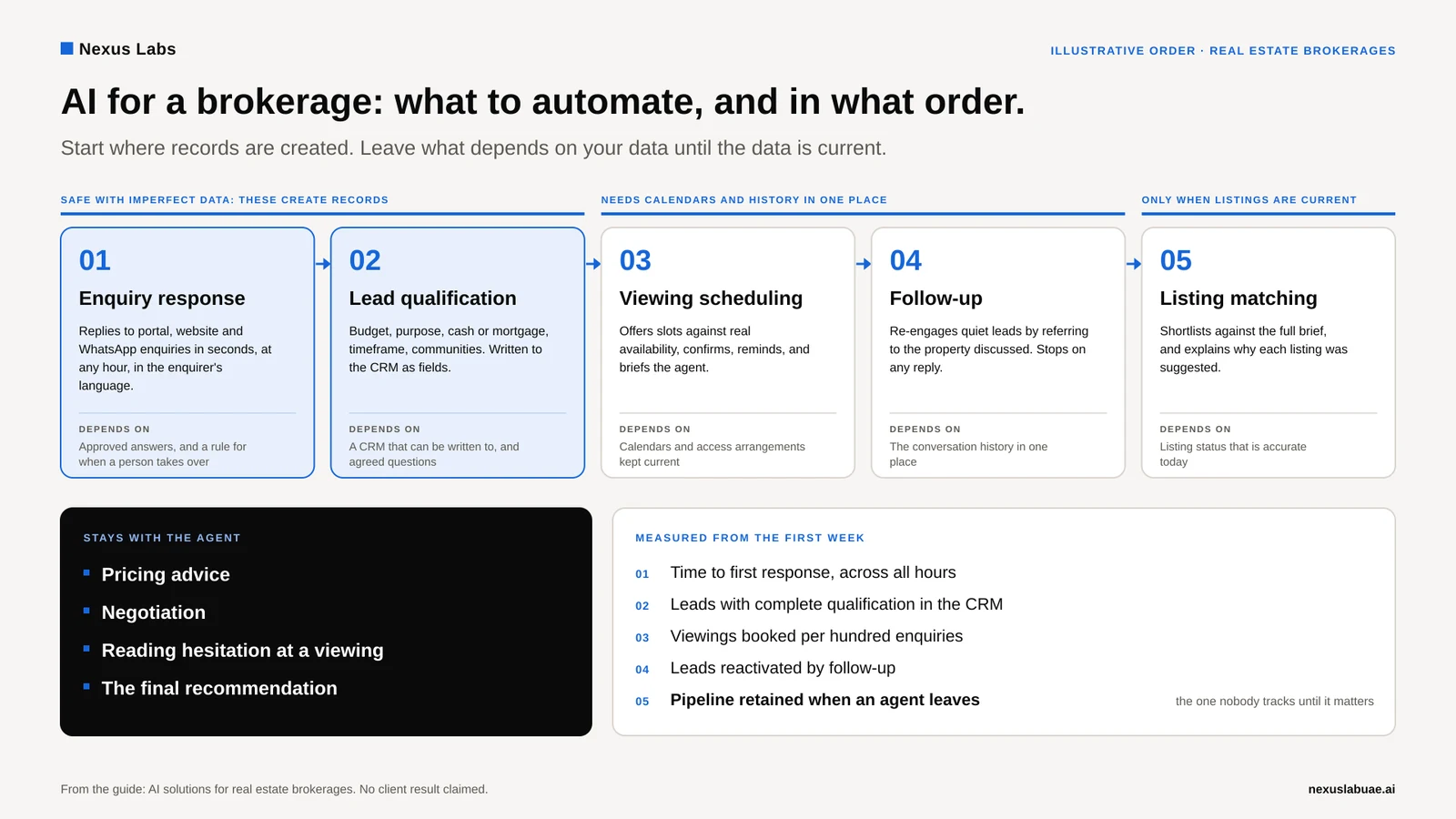
An AI solution for a real estate brokerage is a layer that sits on top of the CRM, the listing database and the messaging channels the brokerage already uses, and takes over the repetitive part of the path from enquiry to viewing. It replies to every enquiry at once, asks the qualification questions, books viewings, follows up the leads that go quiet and shortlists listings against the client's brief. Start with first response and qualification, because they create clean records rather than depending on them. Leave matching, and anything that publishes listing content, until the data underneath is current. Pricing advice, negotiation and the final recommendation stay with a licensed agent.
The Five AI Solutions a Brokerage Actually Uses
Stripped of product names, there are five, and each depends on something the brokerage has to supply.
| Solution | What it does | What it depends on |
|---|---|---|
| Enquiry response | Replies to portal, website and WhatsApp enquiries within seconds, at any hour, in the enquirer's language. | Approved answers about the brokerage and its listings, and a rule for when a person takes over. |
| Lead qualification | Asks about budget, purpose, finance, timeframe and location, and writes the answers to CRM fields. | A CRM that can be written to, and qualification questions the sales team has agreed. |
| Viewing scheduling | Offers slots against real availability, confirms, reminds and tells the agent who is coming and why. | Agent calendars and access arrangements that are kept current. |
| Follow-up | Re-engages leads that have gone quiet, referring to the property discussed, and stops on any reply. | The conversation history in one place, and an opt-out that is honoured. |
| Listing matching | Shortlists listings against the full brief and explains why each one was suggested. | Listing status that is accurate today, not last month. |
Two further uses come up in almost every conversation: drafting listing content, and supporting valuation. Both are useful and both carry limits that matter more in this market than elsewhere. They are covered below.
Where the Hours Go Before Automation
The case for automation in a brokerage is rarely about cost. It is about four places where enquiries are lost without anyone deciding to lose them.
- The slow first reply. An agent who is in viewings from mid-morning cannot answer the enquiry that arrives at eleven, and nobody answers the one that arrives at eleven at night. A buyer comparing similar units has usually contacted more than one brokerage, and the first useful reply tends to get the conversation.
- The unsorted list. Portal leads, WhatsApp messages, calls and walk-ins land in the same queue in the order they arrived. The cash buyer ready to move this month sits behind twenty people who are browsing.
- The follow-up that stops. Most leads are not lost to a competitor. They are lost to silence after the second attempt, because chasing is tedious and the outcome is uncertain.
- The context that leaves. What a client actually wants is said in conversation, stays in one agent's message history, and leaves the brokerage when that agent does.
Each of the five solutions above closes one of these. None of them requires replacing the CRM or the portals; the layer connects to what is already there.
Listing Content and Valuation: Useful, With Limits
Listing content. AI will turn a listing's recorded facts into a description, shorten it for a portal, and translate it for buyers who read Arabic, Russian or Mandarin. The limit is that a model asked to make a unit sound appealing will happily describe a sea view the unit does not have. Every claim in a description has to come from the listing record, and a person with authority has to approve it before it is published. In Dubai that is not only good practice: property advertising requires a permit issued through the Dubai Land Department's Trakheesi system, the advertisement has to match the permit, and responsibility for what is advertised stays with the brokerage. Automation drafts. It does not publish.
Valuation support. AI can assemble comparables faster than a person can: recent transactions, asking prices, service charges and time on market for similar units. That is a starting point for an agent's judgement and a better-prepared conversation with a seller. It is not a valuation, and it should never be presented to a client as one. A formal valuation is a regulated professional activity, and the agent's knowledge of a building, a developer and a street is precisely what the comparables do not contain.
Lead Qualification in Practice
Brokerage lead volume is high and quality is uneven. Portal enquiries, WhatsApp messages, walk-ins and referrals arrive together, and the majority are not ready to transact. The cost is not the unqualified leads themselves — it is that qualifying them manually consumes the hours that should go to the ones that are ready.
Qualification is well suited to automation because the questions are consistent and the answers are structured: budget range, intended use, whether a mortgage is required or the purchase is cash, timeframe, whether the buyer is resident or overseas, and which communities are actually in scope. Those answers can be collected conversationally, in the enquirer's language, and written to the CRM as fields rather than left in a chat log.
What this changes is the shape of an agent's day. Instead of working a list in the order it arrived, they open a list already ordered by readiness, with the context attached.
Property Matching That Reflects the Brief
Matching is where brokerages most often disappoint enquirers, usually by sending everything that fits the price filter. A brief is rarely only about price: it contains a school run, a commute, a handover date, a service-charge tolerance and a view preference, most of which are stated in conversation and never captured in a field.
An AI layer connected to the listing database can hold those stated constraints and apply them, including the ones nobody built a filter for. It can also explain why a property was suggested, which is the difference between a shortlist a client trusts and a list they scroll past.
Follow-Up That Does Not Read as Automated
Most brokerage leads are lost to silence rather than to competitors. Follow-up stops after the second attempt because it is tedious and because the outcome is uncertain. Automated follow-up solves the persistence problem and introduces a different risk: sequences that are obviously generic perform worse than no follow-up at all.
The distinction is whether the message refers to something specific — the property discussed, the constraint mentioned, the handover date that matters — and whether it stops when the client responds or asks it to. Persistence without responsiveness is not follow-up; it is pressure, and on a personal messaging channel it costs the relationship.
What Is Specific About the UAE Market
Several characteristics change how AI is deployed in a UAE brokerage compared with elsewhere:
- Off-plan sales involve payment plans, handover timelines and developer-specific terms. Enquirers ask about these in detail, and answers must come from current developer documentation rather than from a model's general knowledge.
- The buyer base is international. Enquiries arrive in Arabic, English, Russian, Mandarin and Hindi, frequently from buyers in other time zones. Both language coverage and out-of-hours response are functional requirements.
- Regulation is specific. Brokerage practice in Dubai operates under RERA rules covering agent registration, listing permits and advertising. Automated content that touches listings has to respect those requirements, and responsibility for compliance stays with the brokerage.
- WhatsApp is the working channel. Most client conversation happens there, which is why connecting AI to CRM and WhatsApp matters: AI that cannot operate on WhatsApp is not operating where the business is done. The rules and charges that apply are set out in WhatsApp AI rules for UAE businesses.
- Agent turnover is high. When an agent leaves, their pipeline frequently leaves with them because the context lived in their phone. Automation that writes to the CRM as a by-product of conversation keeps that context with the brokerage.
What to Automate First
A sensible sequence for a brokerage, in order:
- Instant first response to inbound enquiries, at any hour, in the enquirer's language. This is the lowest-risk change and the one enquirers notice.
- Structured qualification written to the CRM, so the agent inherits answers rather than a transcript.
- Viewing scheduling against real availability, with confirmations and reminders.
- Follow-up sequences for leads that go quiet, stopping on any reply.
- Listing matching and explanation, once the data underneath is reliable enough to act on.
Pricing advice, negotiation and final recommendations belong with the agent. The value of automation here is that it protects the hours in which those conversations happen.
Data: The Part That Decides Whether Any of This Works
AI applied to a brokerage's data inherits that data's condition. Three problems are near-universal and each has a direct effect:
- Duplicate contacts. The same buyer enquiring through three portals becomes three leads, receives three sets of follow-up and appears in reporting as three opportunities. Automation multiplies the consequence, because now all three get contacted reliably.
- Listings that are out of date. Nothing damages a client relationship faster than being shown a property that sold last month. If listing status is not current, matching should not be automated yet.
- Context living in phones. The single most valuable dataset in most brokerages — what each client actually wants — is held in individual agents' message histories and leaves when they do.
The practical implication is sequencing. Automating first response and qualification is safe even with imperfect data, because those create records rather than depending on them. Automating matching and recommendation is not, because those act on what already exists.
Measuring the Change
Useful measures for a brokerage deployment are operational and available immediately:
- Time to first response, measured across all hours. Enquiry response speed correlates strongly with conversion in a market where buyers contact several brokerages at once.
- Proportion of leads with complete qualification data in the CRM, rather than a chat log requiring interpretation.
- Viewings booked per hundred enquiries, which is the first point where qualification quality becomes visible.
- Leads reactivated by follow-up after going quiet — the pipeline that would previously have been written off.
- Pipeline retained when an agent leaves, which is the measure nobody tracks until it matters.
Commission attribution takes a full transaction cycle to establish, and in a market with long off-plan timelines that is months rather than weeks. Early revenue claims in this sector rarely survive examination.
What This Does Not Replace
It is worth being explicit, because the claim that AI replaces agents is both common and wrong in this sector. Property transactions in the UAE involve a buyer making one of the largest financial decisions of their life, frequently from another country, in a regulatory environment they do not know well. The parts that decide whether a deal closes — reading hesitation in a viewing, knowing which developer actually delivers on handover dates, negotiating when a seller is emotional — are not automatable and are not close to being so.
What automation removes is the layer of work that prevents agents from doing that: the qualification calls that go nowhere, the follow-up that never happens, the data entry that happens badly. The brokerages seeing results treat AI as protection for agent time rather than as a substitute for it.
How Nexus Labs Works With Brokerages
Nexus Labs is an AI lab in Dubai that builds AI employees for businesses in the UAE and the wider GCC. For real estate and property firms the work covers enquiry response and lead qualification, listing cleanup across portals, follow-up sequences and daily management reporting. Three things about how we do it are worth knowing before a first conversation:
- We connect, we do not replace. Your CRM, your portals and your WhatsApp number stay where they are. The AI layer goes on top and nothing is migrated.
- We start with one workflow. Usually first response and qualification on one channel, expanded when it has earned its place.
- We implement. The deliverable is a working system your agents use, not a report about one.
The roles are described on the custom AI agents page and the sectors on the industries page. To see an AI sales employee run against your own enquiry flow, get in touch.
Where to Go Next
Most brokerage enquiries arrive on WhatsApp before they reach a CRM, which is covered in CRM and WhatsApp integration. For Arabic-speaking enquirers, see Arabic AI customer service in the UAE. For the reporting side, meaning commission, pipeline and listing performance, see AI-powered reporting. For sales stands and launch events, where every agent is busy at peak times, see digital humans for business in the UAE. Once the lease is signed, AI for property management in Dubai covers maintenance, renewals and owner reporting. If the question is what an AI employee is in the first place, start with AI employees in the UAE. Our AI services page covers all of it. For how a brokerage engagement runs with us, see how we work as an AI automation company in Dubai.
Frequently Asked Questions
What is the best first AI use case for a real estate brokerage?
First response and lead qualification on the channels where enquiries already arrive, usually portal leads and WhatsApp. It is the lowest-risk place to start because it creates clean CRM records rather than depending on existing ones. Define when a person takes over, record consent and data-handling rules, and measure response time, completed qualifications and viewings booked before expanding scope.
Will AI replace real estate agents?
No. It replaces tasks, not agents. Qualification calls, reminders, data entry and routine follow-up can be automated. Reading hesitation at a viewing, advising on price, knowing which developer delivers on time and negotiating between a buyer and a seller cannot, and those are the parts that decide whether a deal closes. The practical effect is that agents spend more of the day on them.
Can AI answer property enquiries on WhatsApp?
Yes. It connects through the WhatsApp Business Platform rather than the free WhatsApp Business app, replies inside the conversation the customer started, and writes what was said into the CRM. The brokerage decides in advance when a person takes over: always when the customer asks for one, and whenever the conversation turns to price, terms or a complaint.
Which languages can an AI assistant handle for property enquiries?
Arabic and English as standard, including enquirers who switch between the two in one conversation. Current language models also handle Russian, Mandarin, Hindi and the other languages UAE buyers write in. Detect the language from the enquirer's own message, and have a native speaker review the fixed wording, such as greetings, disclaimers and handoff messages, in every language you rely on.
Does AI work with our existing CRM and property portals?
It should. A well-built AI layer connects to the CRM you already run and nothing is migrated. Portal enquiries normally reach the CRM by lead feed or email, and the AI layer works from there. What matters is whether the CRM can be read from and written to, and whether listing status in it is current. If a provider's first recommendation is to replace your CRM, ask why.
How long does it take to deploy AI in a brokerage?
A single workflow, such as first response and qualification on one channel, can be live in weeks where the CRM allows connection and the sales team has agreed the qualification questions. The timeline is driven by the state of the data and the number of systems involved, not by the AI. A provider quoting a fixed timeline before seeing your workflow is quoting a template.
Can AI provide property valuations without a valuer?
No. AI can assemble comparable transactions, asking prices and service charges quickly, which prepares an agent for a pricing conversation. It should not be presented as a substitute for a qualified valuation, local market knowledge or any regulated appraisal process. Use authorised data sources and keep professional review for every high-stakes decision.
Can AI write and publish our property listings?
It can draft them, from the facts in the listing record, and translate them. It should not publish them. In Dubai a property advertisement needs a permit issued through the Dubai Land Department's Trakheesi system and has to match that permit, so a person with authority approves every listing before it goes live. Responsibility for advertising compliance stays with the brokerage.
How should a brokerage protect client data when using AI?
Start with data mapping, role-based access, data minimisation, approved integrations and documented human escalation. Decide deliberately where client data is processed, since the UAE's Personal Data Protection Law sets obligations on processing and cross-border transfer. Confirm the applicable privacy and sector obligations with your legal and information-security advisers before deployment. This is operational guidance, not legal advice.
How do we know whether it is working?
Measure what is visible from the first week: time to first response across all hours, the share of leads with complete qualification data in the CRM, viewings booked per hundred enquiries, and leads reactivated by follow-up. Commission attribution takes a full transaction cycle, which in an off-plan market is months. Add one measure most brokerages never track: how much of the pipeline stays when an agent leaves.