AI Governance and Data Privacy in the UAE: What You Must Be Able to Show
Which regimes govern AI and personal data in the UAE (federal PDPL, DIFC, ADGM, sector rules), the six documents governance requires, the controls that cost little, and four guides that go deeper.
AI governance, for a business in the UAE, is the set of decisions and documents that let you show who is accountable for each AI system, what personal data it touches, where that data goes, how long it is kept, and who can stop it. It is not a statement of principles. When a regulator, a client's compliance team or a procurement panel asks, they ask for documents, and the organisations that struggle are rarely the ones with bad intentions. They are the ones that never wrote anything down.
This guide is for the person who has to answer those questions: the managing director, operations head or IT lead of a Dubai or UAE business that is deploying, or about to deploy, AI agents against customer data. It covers which rules apply, what governance actually requires you to produce, where AI creates obligations ordinary software does not, the controls that cost little, and the common mistakes. It is the pillar of our security-and-governance guides: four companion guides go deeper on the platform, on WhatsApp, on documents and on health data, and they are listed below. It is operational guidance, not legal advice; take your own on which regimes apply to your structure.
The short answer
Three things. First, work out which regime governs each of your legal entities, because the federal Personal Data Protection Law, the DIFC law and the ADGM regulations are separate, and a group can be under all three at once. Second, produce six documents: an inventory of AI systems, a lawful basis for each processing activity, an impact assessment for higher-risk uses, a retention position for prompts and logs, a transfer record for anything processed outside the UAE, and a defined human oversight for each system. Third, take the handful of design decisions that cost almost nothing before go-live: a scoped role per agent, a human gate on consequential actions, log retention that someone decided, and the region chosen on the compliance position rather than on latency. Everything else in this guide is detail on those three.
What is different in the UAE
Most of the governance advice available online is written for the EU, and the principles travel. Four things about doing this in the UAE do not.
- Three data protection regimes, and sector rules on top. The federal PDPL (Federal Decree-Law No. 45 of 2021) governs the mainland. The Dubai International Financial Centre and Abu Dhabi Global Market each have their own data protection law and their own commissioner. A company with a DIFC entity and a mainland entity answers to two regulators for what looks, from inside, like one system. Health data and financial data carry further rules from their own authorities, often stricter on where the data may sit. The practical consequence is in the next section.
- The AI-specific rules are arriving, unevenly. The DIFC was early: since 2023 its Data Protection Regulations have included a regulation on personal data processed through autonomous and semi-autonomous systems, which requires those deploying such systems to tell affected individuals that a system is being used and what it does, to assess and document the risks before higher-risk processing, and to let people object; for high-risk commercial use the conditions include an appointed autonomous systems officer. At federal level, the UAE announced a Federal Authority for Artificial Intelligence and Data in June 2026, to set national AI and data policy and propose legislation. At the time of writing it has not issued rules binding on private companies, and the PDPL's own implementing regulations, which will settle much of the detail, have still not been published. Build to the stricter position now and you will not have to rebuild when they are.
- The region question is live. Inference for the models most teams want often runs outside the country, even on platforms with a UAE presence, so the prompt and whatever personal data it carries cross a border to be answered. Where the data physically goes is a design decision with a compliance consequence, and it is the subject of securing enterprise AI on AWS Bedrock in the UAE.
- The prompt is the customer conversation. In a UAE service queue the data in the request is a WhatsApp thread in Arabic and English, an image of an Emirates ID, a complaint. The logs hold all of it. Governance here starts with what an agent is allowed to see, not with a policy document.
How this guide and its four companions fit together
Governance is one subject with four places where it gets technical. This guide holds the framework: which regimes, which documents, which controls. The companions each take one of those places:
- Securing enterprise AI on AWS Bedrock in the UAE: what the platform secures, what you configure and what you design; the UAE Region and cross-Region inference; a deployment checklist.
- WhatsApp AI chatbot rules in the UAE: Meta's terms for AI on WhatsApp, the October 2026 charges, and what both mean for the design of an agent on the channel most UAE customer data moves through.
- AI document processing in the UAE: Emirates IDs, passports, invoices and contracts, the most sensitive data most businesses hold, and the retention and minimisation questions that come with reading them automatically.
- AI for clinics and healthcare in the UAE: the sector where residency decides everything, and what may and may not be automated around patient data.
Read this one first; each of the four assumes it.
Which Rules Apply to You
"UAE AI governance" is not one framework, and the most common mistake is assuming federal compliance covers everything. A group with entities in a free zone and on the mainland can be subject to three separate data protection regimes at once.
- Federal PDPL. The UAE's Personal Data Protection Law applies broadly and covers lawful basis for processing, data subject rights, security obligations and cross-border transfer.
- DIFC. The Dubai International Financial Centre has its own data protection law and its own commissioner. An entity registered there is assessed against that regime, not the federal one.
- ADGM. Abu Dhabi Global Market likewise operates its own framework with its own regulator.
- Sector regulators sit on top. Health data and financial services data carry additional obligations from their own authorities, frequently stricter on residency and retention than the general position.
The practical first step is not technical. List your legal entities, and for each one write down which regime governs it and where its data physically sits. Most organisations have never done this, and it is the document every subsequent decision depends on. This is operational guidance rather than legal advice; take your own on which regimes apply to your structure.
What Governance Actually Requires You to Produce
Governance frameworks are often discussed as principles. In practice, what a regulator or a client's compliance team asks for is documents and evidence.
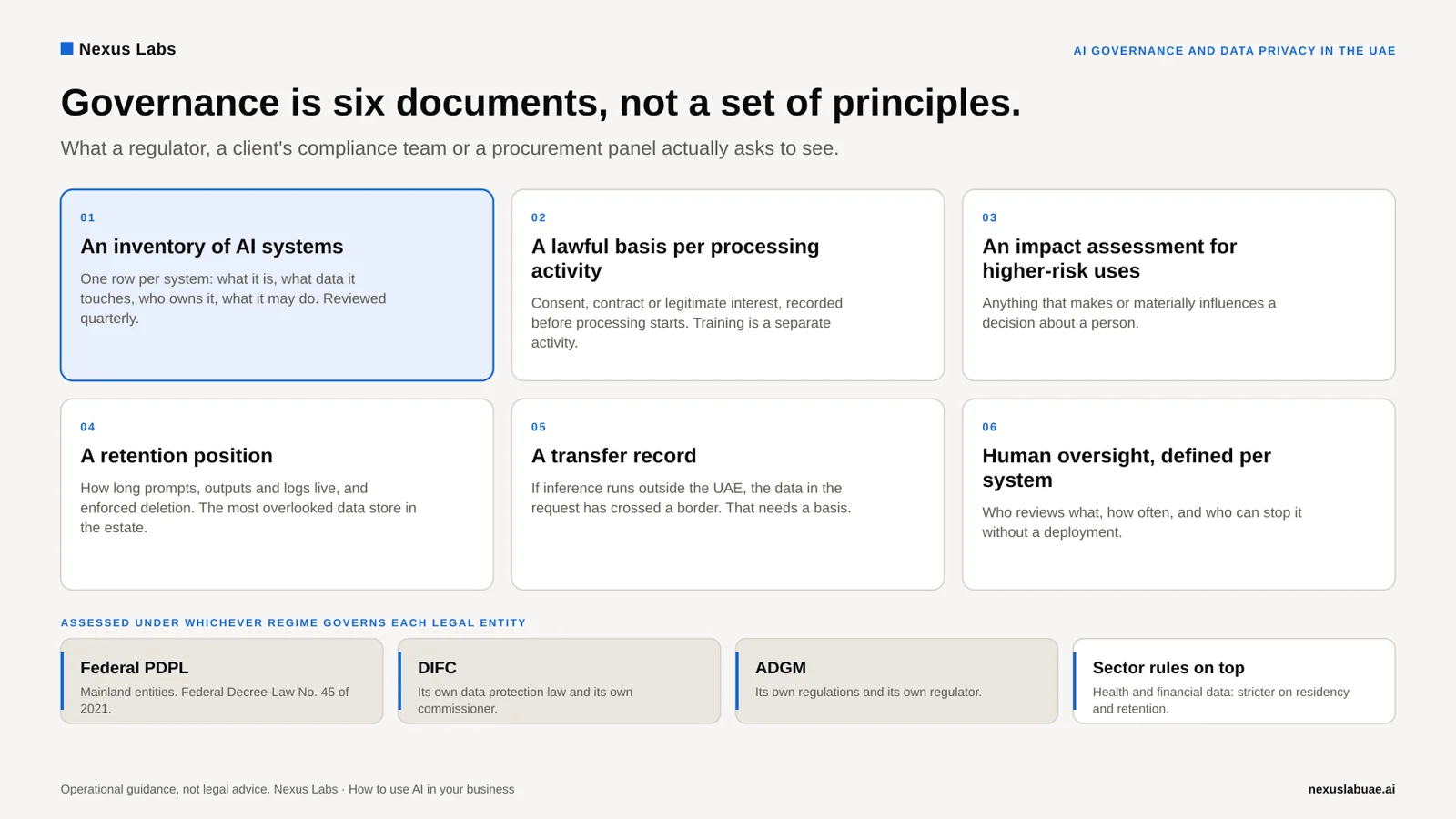
- An inventory of AI systems. What is deployed, what data it touches, who owns it, what it is permitted to do. Most organisations cannot produce this and discover so under time pressure.
- A lawful basis for each processing activity. Consent, contract, legitimate interest — recorded before processing starts, not reconstructed afterwards.
- An impact assessment for higher-risk uses. Anything making or materially influencing decisions about people.
- A retention position. How long prompts, outputs and logs are kept, and enforced deletion. AI systems accumulate personal data in logs by default, and this is the most commonly overlooked store in the entire estate.
- A transfer record. If inference runs outside the UAE, that is a cross-border transfer of the data in the request, and it needs a basis.
- Human oversight, defined per system. Who reviews what, how often, and who can stop it.
Where AI Creates Obligations Ordinary Software Does Not
- Training and fine-tuning are processing. Using customer records to fine-tune a model is a distinct processing activity from serving those customers, and usually needs its own basis. It is also frequently irreversible in a way that complicates deletion requests.
- Logs contain what the request contained. Prompt and output logs hold the same personal data as the conversation. They are routinely stored longer, in a different region, and with broader access than the source system — and they are rarely covered by anyone's retention policy.
- Explanation is expected. Where a system materially affects someone, being able to say why is not just good practice. Design the logging to answer it, because reconstructing it later is usually impossible.
- Deletion has to reach everywhere. A data subject request has to cover the CRM, the vector store, the conversation history and the logs. Systems built without this in mind cannot satisfy it without engineering work.
Practical Controls That Are Not Expensive
Governance is often assumed to require a programme. Most of the value comes from a small number of decisions taken early.
- Scope each agent's access to what it needs. Per-agent credentials, not a shared account with broad read access because it was quicker.
- Put a human gate on consequential actions. Sending, paying, deleting and communicating externally. Reading and drafting do not need one.
- Set log retention deliberately, and enforce it. Ninety days is a defensible default for most operational logging. Indefinite is not.
- Choose the region on the compliance position, not on latency. A few milliseconds is not worth a residency answer you cannot give.
- Keep the inventory current. One row per system, reviewed quarterly. This single document answers most of what anyone will ask you.
- Write down what the system must never do. Explicit prohibitions are easier to test and easier to audit than aspirational principles.
Common Mistakes
- Treating a pilot as out of scope. Pilots process real personal data and the obligations apply from the first record.
- Assuming a vendor's certifications transfer. A platform's compliance describes the platform. Your deployment on it is assessed separately.
- Confusing free zone and federal. A DIFC entity is not covered by federal compliance, and vice versa.
- Forgetting the logs. The most frequently missed personal data store in an AI deployment.
- Writing a policy nobody implements. A framework document with no inventory behind it demonstrates intent and nothing else.
Why This Is Worth Doing Beyond Compliance
The governance work has a commercial return that is rarely stated. Enterprise and government buyers in the UAE increasingly ask these questions during procurement — where data is processed, what the retention position is, who reviews the outputs. A supplier who answers immediately, with documents, is materially easier to buy from than one who has to go and find out.
The organisations that treat this as a sales asset rather than a cost tend to do it once, properly, and reuse the answers. The ones that treat it as overhead answer the same questions from scratch in every procurement cycle.
Where to Go Next
If you need the staff-facing piece first, our AI use policy template for UAE businesses is a two-page policy you can adapt today. The four companion guides above go deeper on the platform (AWS Bedrock in the UAE), the channel (WhatsApp AI rules), the documents (AI document processing) and the strictest sector (clinics and healthcare). For where the controls physically sit in an architecture, see the operating layer; for the questions to put to a provider about where your data is processed and who is accountable, see choosing an AI automation company in Dubai. Our AI services page describes how we build to these rules, and custom AI agents what a scoped, logged agent looks like in practice. And for how an engagement runs, see how we work as an AI automation company in Dubai.
Frequently Asked Questions (FAQ)
Is there an AI law in the UAE?
Not a single one, at the time of writing (October 2026). AI that processes personal data falls under the federal Personal Data Protection Law (Federal Decree-Law No. 45 of 2021) on the mainland, and under the DIFC or ADGM data protection regimes for entities registered there; the DIFC's regulations include one specifically on autonomous and semi-autonomous systems. The UAE announced a Federal Authority for Artificial Intelligence and Data in June 2026 to set national AI and data policy and propose legislation, but it had not issued rules binding on private companies, and the PDPL's implementing regulations were still unpublished. Build to the stricter position now. This is general information, not legal advice.
What are the main AI governance regulations in the UAE?
There is no single UAE AI law in force at the time of writing. The obligations come from the data protection regimes: the federal PDPL (Federal Decree-Law No. 45 of 2021) on the mainland, and the DIFC and ADGM laws in the financial free zones, each with its own regulator; from sector rules on health and financial data; and, in the DIFC, from a 2023 regulation on personal data processed through autonomous and semi-autonomous systems. A Federal Authority for Artificial Intelligence and Data was announced in June 2026 to set national policy and propose legislation. Check what it has issued since this was written.
Does AI governance apply to a pilot?
Yes, from the first record. A pilot processes real personal data, usually with broader access than production would be given, and the lawful basis, the retention of its logs and any cross-border processing are assessed exactly as they would be for a live system. The cheapest time to scope an agent's access and decide a retention period is before the pilot, because the pilot's permissions tend to become production's.
What is the first thing to do?
Two documents. List your legal entities, and for each one the regime that governs it and where its data physically sits. Then list your AI systems, one row each: what it is, what data it touches, who owns it, what it may do. Most organisations have never produced either, and every later decision depends on them.
We have entities in a free zone and on the mainland. Does one compliance position cover both?
No. DIFC and ADGM each operate their own data protection law with their own regulator, separate from the federal PDPL. A group spanning a free zone and the mainland can be subject to three regimes at once. Start by listing every legal entity with the regime that governs it and where its data physically sits — most organisations have never produced that document, and every later decision depends on it.
Do our AI logs count as personal data?
If the conversation contained personal data, the logs do too. Prompt and output logs are the most frequently overlooked personal data store in an AI deployment: they are routinely kept longer than the source system, stored in a different region, and accessible to more people, and they are rarely covered by anyone's retention policy. Set a deliberate retention period and enforce deletion.
Does a vendor's compliance certification cover our deployment?
No. A platform's certifications describe the platform. Whether your configuration has a lawful basis, whether your retention is defensible and whether your cross-border transfers have a basis are all assessed against your implementation. Managed services shift work; they do not transfer responsibility.