AI Customer Service Automation in the UAE: What to Automate First
A practical guide to automating customer service with AI agents for Dubai and UAE businesses: which queries to automate first, what has to be true before it works, what WhatsApp and a bilingual queue change, and how to measure resolution rather than deflection.
AI customer service automation is the use of an AI agent to read every enquiry as it arrives, answer the ones with a known answer from live records, collect what a person will need for the rest, and hand those over with the whole conversation attached. The difference from the chatbot most businesses have already tried is that the agent works inside the systems the service team already uses (the CRM, the order system, the booking calendar, WhatsApp) instead of guessing from a script. In the UAE that difference decides whether the thing gets used at all, because most of the queue arrives on WhatsApp, in Arabic and English, outside anyone's working hours.
This guide is for the person who owns the service queue and has to decide what to automate, in what order, and how to know whether it worked. It covers what an AI customer service agent does in practice, which queries to automate first and which to leave with people, what has to be true before it works, what WhatsApp and a bilingual queue change about the design, how it fails, and how to measure it. It is written for businesses in Dubai and the UAE; the method holds anywhere.
The short answer
Automate the first response and the status questions first, on one channel, and measure resolution rather than deflection. Give the agent read access to the systems that hold the answers, and keep anything that moves money or changes a booking behind a human approval step until it has a track record. Make the route to a person visible, and make the hand-over carry the conversation. Then review what it got wrong every week, with someone who has the authority to change it. Most of the work is in the knowledge base and the integration, not the model.
What an AI customer service agent does, in practice
Three kinds of system are sold as AI customer service, and the first two are the ones most people have met.
- Scripted chatbots follow a decision tree. They are fine for a menu of five options and infuriating for anything else, which is why "talk to a human" is the most typed phrase in customer service.
- AI assistants answer questions from documents. They understand what was asked far better than a script does, but they stop at the answer. Nothing in the business changes because they spoke, and they cannot tell a customer where the order is because they cannot see it.
- AI agents read the message, decide what it is, look the answer up in the live system, reply in the language the customer used, and either close the conversation or hand it to a person with everything collected. The distinction is worked through in AI agents versus chatbots; this guide is about the third kind.
In a service queue the agent's work falls into five jobs, listed here in the order it is sensible to switch them on:
- The first reply. Within seconds, at any hour, in Arabic or English, with an answer to what was actually asked rather than an acknowledgement.
- Status answers from live records. Orders, deliveries, bookings, applications, renewals: the questions that make up most of the volume and that a person answers by looking something up.
- Triage. The urgent case brought to the front and the rest routed to the right team, so the queue is no longer read in the order it arrived.
- Collection. The four or five things a person will need (the reference, the account, what was already tried, what the customer wants), asked before the ticket reaches them.
- The hand-over. The transcript in its original language, the customer record and what was already attempted, travelling with the escalation so the customer never repeats themselves.
Everything else, including anything that moves money or changes a booking, is decided per query type in the next section.
Where the value sits for a UAE business
The gains are availability and consistency gains rather than intelligence gains, and they cluster in the places a Gulf service operation is stretched.
- Out of hours. Enquiries arrive in the evening, at the weekend, during Ramadan hours and from customers in other time zones. The share of messages that get any reply before the next shift starts is usually the first number that moves.
- Two languages, one queue. Arabic and English in the same conversation is routine, and staffing both across every shift is expensive. One maintained knowledge base, answered in the language the customer used, with native speakers reviewing the wording. The design decisions are in Arabic AI customer service in the UAE.
- WhatsApp as the front door. Most of the queue is a continuous WhatsApp thread rather than a ticket, and Meta's 2026 rules change what an AI agent may do there and what the replies cost. See WhatsApp AI chatbots in the UAE: the 2026 rules.
- The record. Every conversation written to the CRM, so the customer's history is not in one person's phone. The integration side is covered in CRM and WhatsApp integration.
Sales enquiries are a different queue with a different owner, covered in AI sales agents in the UAE. What stays with people in service is set out below, and it is more than most vendors admit: complaints that have escalated, anything regulated, anything where the customer is distressed, and every decision that costs money to reverse.
What to Automate First, and What to Leave Alone
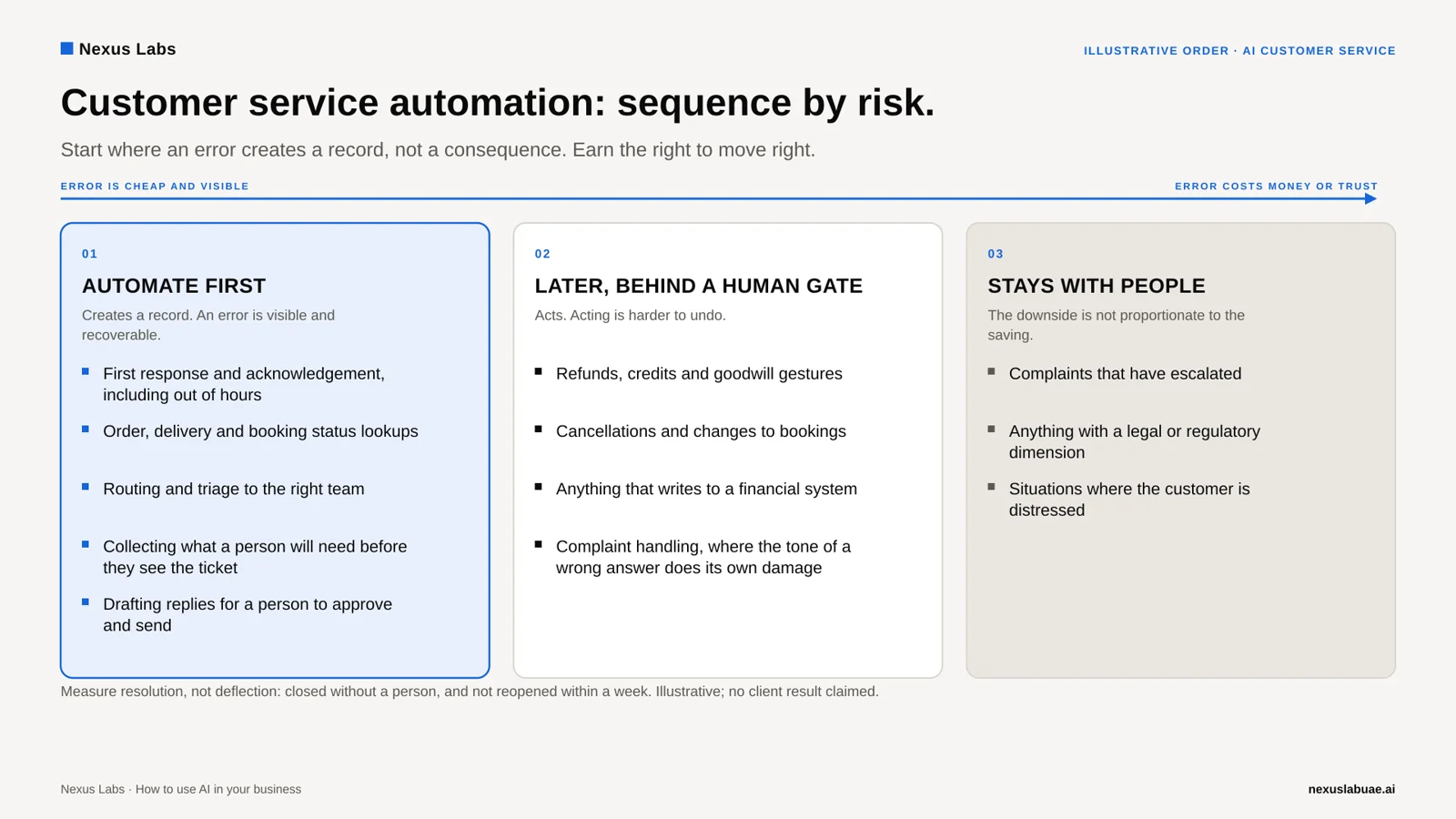
The most common failure in customer service automation is starting with the hardest queue because it is the most painful. Sequence by risk instead, and the project survives its first mistake.
Safe to automate early — these create a record rather than a consequence, so an error is visible and recoverable:
- First response and acknowledgement, including out-of-hours
- Order, delivery and booking status lookups
- Routing and triage to the right team
- Collecting the information an agent will need before a human sees the ticket
- Drafting replies for a human to approve and send
Automate later, with a human gate — these act, and acting is harder to undo:
- Refunds, credits and goodwill gestures
- Cancellations and changes to bookings
- Anything that writes to a financial system
- Complaint handling, where the tone of a wrong answer causes its own damage
Leave to people: complaints that have escalated, anything with a legal or regulatory dimension, and situations where the customer is distressed. The economics of automating these are poor and the downside is not proportionate to the saving.
What Has to Be True Before It Works
Customer service automation fails on inputs far more often than on the model.
- Answers have to exist somewhere. If the correct response lives in three agents' heads and a spreadsheet, the agent will invent something plausible. Assembling the knowledge base is usually the largest piece of work and it is rarely in the plan.
- The knowledge has to be current. A confidently delivered out-of-date policy is worse than no answer, because the customer acts on it and you are bound by what you said.
- Handover has to carry context. The single most reliable way to make customers hate an AI system is to make them repeat themselves to the human who picks up. The transcript, the customer record and what was already attempted must travel with the escalation.
- Someone has to own the failures. A weekly review of what the agent got wrong, with the authority to change the configuration. Without it, quality decays quietly.
Channels, and Why WhatsApp Changes the Design
In the UAE a large share of customer conversation happens on WhatsApp, and it behaves differently from email or web chat in ways that affect the build.
- Conversations are continuous. There is no session boundary. A customer replies three days later in the same thread and expects the context to be there.
- Template rules apply. Business-initiated messages outside the customer service window need approved templates. Design your escalation and follow-up flows around that constraint rather than discovering it at launch.
- It becomes a system of record. If a meaningful part of your customer history exists only in message threads, reporting built solely on the CRM will understate everything, and nobody notices because the dashboard looks complete.
- Voice notes and images arrive. Decide what happens to them. Silently ignoring a voice note reads as being ignored.
Language, in a Market That Uses Two
Arabic and English coexist in the same queue, frequently in the same conversation. Three things worth deciding deliberately:
- Detect, do not assume. Route on the language the customer actually used, not on their profile or their number's country code.
- Test Arabic output with native speakers before launch. Formal Modern Standard Arabic can read as stiff or bureaucratic in a service context where Gulf dialect would be natural. This is a judgement call your team can make and a model cannot.
- Right-to-left rendering is a real test case. Mixed Arabic and English in one message — a product code inside an Arabic sentence — is where interfaces break.
What Goes Wrong
- The deflection target becomes the goal. Optimising for tickets avoided produces a system that is hard to escape. Measure resolution, not deflection.
- No visible route to a human. Customers who cannot find one escalate publicly instead, on the review sites and social channels you do not control.
- Confident wrong answers. An agent that says "I am not certain, let me get someone" preserves trust. One that guesses spends it.
- Headcount removed too early. The role shifts from answering to reviewing and improving. Organisations that cut the team immediately lose the people who would have caught the wrong answers.
- Launching everywhere at once. One channel, one query type, until it is genuinely good.
How to Tell Whether It Is Working
- Full resolution rate — conversations closed without a human, where the customer did not return with the same question within a week. The follow-up window is what makes this honest.
- Time to first meaningful response, not time to first message. An instant acknowledgement that answers nothing is not a response.
- Escalation quality — how often the human who takes over has to ask the customer something the agent already collected.
- Satisfaction, split by handled-by. If AI-handled conversations score materially lower, the deflection number is hiding a problem.
- Repeat contact rate. The clearest signal that answers are actually resolving rather than deferring.
Where to Go Next
Automating service starts with the channels the enquiries arrive on, covered in CRM and WhatsApp integration, and depends on the agent-versus-chatbot decision in this comparison. If your queue is bilingual, Arabic AI customer service covers what changes — register, code-switching and right-to-left rendering. If the queue is internal rather than external, AI for IT service desks and MSPs covers the same ground with much stricter access control. Our custom AI agents page describes what we build, and to see it running against your own queue, tell us what you handle today.
Frequently Asked Questions
Will AI agents replace our customer service team?
No. The agent takes the first reply, the status questions, the triage and the collection of details; the team's work shifts from answering to reviewing and improving, and to the conversations that need judgement. Organisations that cut the team on day one lose the people who would have caught the wrong answers.
How long does it take to automate customer service with AI?
Weeks for one channel and one query type, where the answers already exist somewhere and the systems that hold them can be read from. Longer where the knowledge base has to be assembled first, which is the normal starting position and usually the largest piece of work. The timeline is set by the state of your answers and your systems, not by the AI.
How is customer data protected in an AI customer service system?
By design rather than by assurance: the agent reads only the records it needs, writes only where you permit, logs what it did, and keeps data where your obligations say it must stay. The UAE's Personal Data Protection Law applies to a pilot as much as to production, and DIFC and ADGM have their own regimes. Decide the access scope and where data is processed before the first conversation. This is operational guidance, not legal advice.
Which queries should we automate first?
The ones that create a record rather than a consequence — first response, status lookups, routing, and collecting information before a human sees the ticket. These are safe to get wrong because the error is visible and recoverable. Refunds, cancellations and anything writing to a financial system should keep a human approval step until the system has a track record.
What if our answers are not written down anywhere?
That is the normal starting position and it is usually the largest part of the work. If the correct response lives in three agents' heads and a spreadsheet, the agent will produce something plausible instead. Assembling and dating the knowledge base comes first — a confidently delivered out-of-date policy is worse than no answer, because the customer acts on it.
How do we handle Arabic and English in the same queue?
Detect the language the customer actually used rather than inferring it from their profile or phone number. Have native speakers review Arabic output before launch: formal Modern Standard Arabic can read as stiff in a service context where Gulf dialect would be natural, and that is a judgement a model cannot make for you. Test mixed messages — a product code inside an Arabic sentence — because that is where right-to-left rendering breaks.