AI-Powered Business Intelligence & Reporting in the UAE
How AI-powered BI and reporting work for UAE businesses: what changes, what your data needs first, the sequence that works, who decides, and what to measure.
AI-powered business intelligence is business reporting in which AI does two jobs a person used to do: it answers questions about the business in plain language, with the workings shown, and it assembles the recurring reports from the systems themselves rather than from spreadsheets someone fills in. It does not replace the definitions, the data or the judgement underneath. Those are still the work, and they decide whether the answers can be trusted.
This guide is for the person in a UAE business who has to decide whether AI-powered reporting is worth doing, and in what order. It covers what changes in practice, what has to be true of your data first, a sequence that works, where it goes wrong, what is different in the UAE and GCC, how to measure it, who decides once it is running, and whether to build or buy. It is written for businesses in Dubai and the UAE; the method holds anywhere.
The short answer
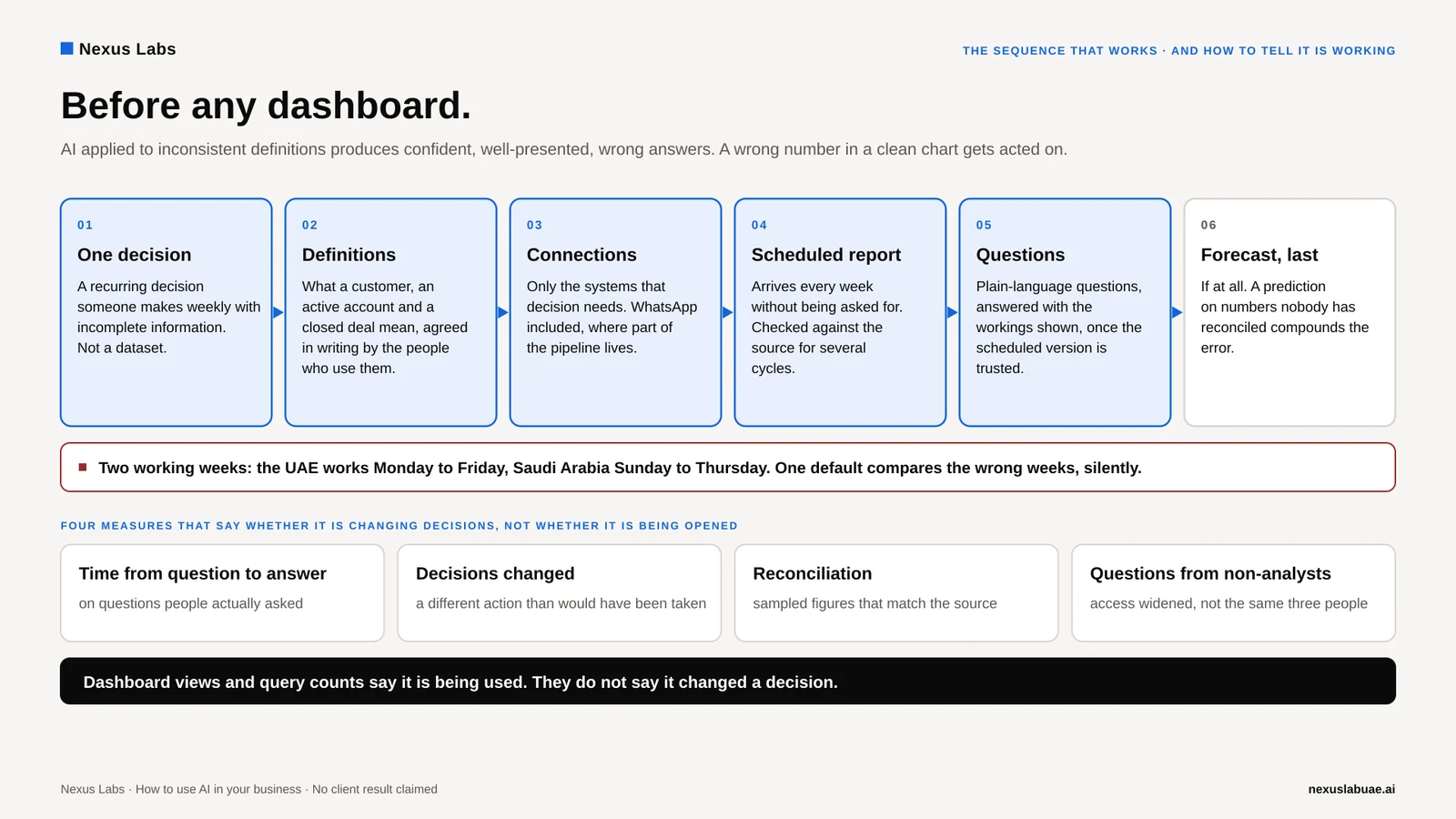
Start with one recurring decision, not a dashboard. Agree in writing the definitions it depends on, connect only the systems it needs, and ship a scheduled report first. Open plain-language questions once the scheduled numbers have been checked against the source for several cycles, and add forecasting last, if at all. In the UAE, build every weekly comparison for the right working week, and include WhatsApp where part of the pipeline lives. Measure decisions changed, not dashboard views.
What it looks like in practice
Three examples of the work, of the kind UAE businesses ask for. Illustrative, not client results.
- The Monday pack. A sales director used to receive the weekly pipeline report on Tuesday afternoon, compiled by hand from the CRM, the accounting system and a spreadsheet of WhatsApp enquiries. Built properly, it arrives on Monday morning, assembled from the systems, with every figure linked to the record it came from and a short note on what changed since last week.
- The question nobody anticipated. "Why did margin drop in the Northern Emirates last month?" Instead of a request to the data team and a wait of several days, the answer comes back with the workings: which clients, which products, which cost lines, and what the system could not see.
- The exception, not the dashboard. Rather than a chart someone has to remember to open, a message to the finance manager when a receivable passes an agreed age, or when one branch's returns run well above the others. The threshold is set by a person and reviewed by a person.
In each case the AI is the interface and the assembly. The value comes from the definitions and connections underneath, which is what most of this guide is about.
From Dashboards to Questions
The defining limitation of traditional business intelligence is not that it produces bad answers. It is that it only answers questions someone anticipated when the dashboard was built. Every organisation running BI has the same experience: the dashboard covers what was important last quarter, and the question that matters this week requires a request to the data team and a wait of several days.
AI changes the interface rather than the data. A layer that understands both natural language and your data model lets someone ask "why did margin drop in the Northern Emirates last month" and receive an answer with the workings shown — rather than filing a request and receiving a chart three days later, by which point the decision has been made without it.
The practical consequence is a change in who can ask. When answering costs a data analyst's afternoon, only questions worth an afternoon get asked. When it costs thirty seconds, the questions people actually have get asked, and those are usually the operational ones that move numbers.
What Has to Be True of Your Data First
This is the section most BI vendors skip and most implementations fail on. AI applied to disorganised data produces confident, well-presented, wrong answers — which is materially worse than no answer, because a wrong number in a clean chart gets acted on.
Four conditions matter more than the choice of tool:
- Definitions are agreed. If "active customer" means something different in sales and finance, an AI layer will answer both ways and neither will be wrong. Reconciling definitions is unglamorous and is the highest-value preparatory work available.
- Data is reachable. Numbers held in individual spreadsheets, personal drives and email attachments cannot be included in an answer. Consolidation into systems that can be queried comes before intelligence of any kind — the data cleaning and organisation layer that precedes reporting.
- History exists and is trustworthy. Predictive and comparative analysis needs enough clean history to establish what normal looks like. Where a system was migrated recently, the pre-migration data usually needs checking before it can be relied on.
- Permissions are modelled. A BI layer that can be asked anything will answer anything it can reach. Salary data, margin by client and commercial terms all need access boundaries defined before the interface is opened, not after someone discovers what it will tell them.
Organisations that treat these as prerequisites succeed. Organisations that treat them as a later phase generally rebuild.
A Practical Implementation Path
A sequence that works, in order:
- Start with one decision, not one dataset. Pick a recurring decision someone makes weekly with incomplete information — reorder quantities, staffing levels, which accounts need attention. Build toward answering that.
- Establish the definitions it depends on and get them agreed in writing by the people who use them.
- Connect the systems that hold the relevant data, and only those. Connecting everything at the start extends the timeline and adds permissions work that delays the first useful answer.
- Produce the scheduled version first. A report that arrives every Monday morning without being requested delivers most of the value and is far easier to validate than an open question interface.
- Open the conversational layer once the scheduled outputs have been checked against reality for several cycles and are trusted.
- Add prediction last. Forecasting on data whose descriptive accuracy has not been established compounds errors rather than revealing patterns.
Where It Goes Wrong
- Trusting output that has not been checked against reality. Every AI-generated figure should be reconcilable to source data, and someone should reconcile a sample regularly. A system nobody audits becomes a system nobody should trust.
- Automating reports nobody reads. Producing the existing report faster does not help if the existing report was already being ignored. Ask what decision each output supports; discontinue the ones that support none.
- Confusing correlation with cause. These systems are good at finding patterns and have no view on which are meaningful. "Sales rise when marketing spend rises" and "sales rise in the same month a competitor closed" look identical to a pattern detector.
- Removing the analyst. The role shifts from producing reports to validating them and asking better questions. Organisations that treat AI BI as a headcount saving usually lose the person who would have caught the wrong answers.
- Ignoring the working week. A system assuming Monday-to-Friday misaligns every weekly comparison in a Sunday-to-Thursday operation, and the error is subtle enough to survive for months.
What This Means for UAE and GCC Businesses
Two regional characteristics are worth designing around. The working week affects every period comparison: the UAE works Monday to Friday, Saudi Arabia and most of the Gulf work Sunday to Thursday, and a group operating across both has two weeks to reconcile. Tools configured with a single default report it wrongly rather than visibly. And where reporting touches personal data — customer records, employee information — the UAE's Personal Data Protection Law sets out obligations covering processing controls, confidentiality and cross-border transfers. Where a BI layer processes such data outside the country, that is a design decision to make deliberately. AI governance and data privacy in the UAE covers the documents that decision needs, and secure enterprise AI on AWS Bedrock covers where inference runs. This is operational guidance rather than legal advice, and organisations should take their own.
Measuring Whether the BI Layer Is Earning Its Place
Business intelligence is unusually prone to being judged on activity rather than outcome. Dashboard views and query counts say a system is being used, not that it is changing decisions. Four measures are more honest:
- Time from question to answer. The gap this technology exists to close. Measure it for real questions people actually asked, not for the ones the dashboard already covered.
- Decisions changed. Harder to capture and worth the effort: how often did a report lead to a different action than would otherwise have been taken? A handful of instances a month justifies most of the cost.
- Reconciliation accuracy. The proportion of sampled figures that match source data on inspection. If this is not consistently near total, nothing else on this list matters.
- Questions asked by non-analysts. The clearest signal that the interface has genuinely widened access rather than becoming a faster tool for the same three people.
Cost savings and revenue effects are real but arrive later and attribute poorly. A BI programme claiming financial returns in its first quarter is usually describing a projection rather than a measurement.
Build or Buy
Most organisations face this choice early and answer it too quickly.
Buying a BI platform with AI features built in is faster to first value and appropriate when your questions resemble everyone else's — sales performance, pipeline, standard financial reporting. The limitation appears when a question depends on how your business specifically works, because the vendor's data model did not anticipate it.
Building a layer over your existing systems takes longer and fits your own definitions, your own permissions model and the systems you actually run. It is the right answer when reporting is a competitive matter rather than an administrative one.
For most mid-sized UAE businesses the honest answer is neither purely: buy the platform for standard reporting, and build the narrow layer for the two or three questions that are specific to how you operate and are worth answering well. Committing entirely to one approach at the outset usually reflects a vendor conversation rather than an assessment of the questions being asked. If you are weighing an external provider, our buyer's guide to business intelligence services in the UAE sets out what to check before signing.
Who decides once it is running
Every decision an AI-powered reporting layer touches sits at one of three levels, and it is worth writing down which before anyone chooses a tool.
- Inform. The system finds and explains; a person decides. Strategy, pricing, hiring, credit for a new client and anything about an individual belong here, and most management decisions stay here permanently.
- Recommend. The system proposes; a named person approves or overrides, with one line of reason that is logged. Reorder quantities, the staffing rota and the collections list are typical, and this is where most of the operational value is.
- Act. The system acts within a written limit and a person reviews afterwards. Only for what is reversible, low in value and high in volume, such as a payment reminder or re-sending a statement. It never commits money and never signs anything.
A decision moves up a level only on a track record. The common failure is not a system that decides too much. It is a recommendation nobody owns, followed because it was on the screen.
Where to Go Next
If you are evaluating providers rather than approaches, our buyer's guide to business intelligence services in the UAE sets out what to check before signing. For the data plumbing this depends on, see CRM and WhatsApp integration. If you are a practice rather than an operating business, AI for accounting and professional services in the UAE covers the reporting-pack workflow specifically. Our AI services page covers the reporting layer.
Frequently Asked Questions
What is AI-powered business intelligence?
Business reporting in which AI answers questions about the business in plain language, with the workings shown, and assembles the recurring reports from the systems themselves. It does not replace the definitions, the data or the judgement underneath; those decide whether the answers can be trusted.
What is a good first AI-powered BI use case?
Start with a recurring executive or operational report that is currently manual, slow, or difficult to reconcile. A useful first use case has named data owners, a clear KPI definition, and an existing decision meeting where the insight will be used.
Do we need a data warehouse before AI-powered reporting?
Not necessarily at the start. Connect only the systems the first decision needs. A warehouse earns its place once several decisions draw on the same consolidated data. Where the numbers are scattered across spreadsheets and inboxes, consolidating them comes first, whatever tool follows.
Can leaders rely on AI forecasts without review?
No. Forecasts should be treated as decision support, not decisions. Teams should expose assumptions, compare predictions with actual outcomes, investigate material deviations, and retain human approval for consequential actions.
How does the Gulf working week affect reporting?
The UAE works Monday to Friday; Saudi Arabia and most of the Gulf work Sunday to Thursday. A group operating in both has two weeks to reconcile, and a tool configured with one default compares the wrong weeks silently. Build every weekly comparison and schedule per market.
How do we protect sensitive data in AI-powered reporting?
Use role-based access, data minimisation, approved source connections, logging, and documented retention rules. Salaries, margin by client and commercial terms need access boundaries before the question interface is opened. The deployment should be reviewed by the organisation's data, privacy, security and legal stakeholders against its own requirements.
How do we know it is working?
Measure four things: time from question to answer on questions people actually asked, decisions changed, the share of sampled figures that reconcile to the source, and questions asked by people who are not analysts. Dashboard views say it is being opened, not that it changed anything.